


A match is not yet a prediction
The examples examined here do not establish that the Qur’an could only have come from God. A verse may fit a later discovery without clearly predicting it. A correspondence may strengthen an existing belief without becoming decisive proof. That limits one argument for the Qur’an’s divine origin; it does not by itself disprove Islam or prove Christianity.
The useful question is simple: before knowing the discovery, what would the words lead us to expect? Check the original wording, its context, older interpretations and what science actually says. A prediction need not contain equations or have led someone to a discovery. But it needs to distinguish the result from plausible alternatives. Otherwise we may be fitting the text to an answer we already know.
Did 21:30 describe the Big Bang?
Qur’an 21:30 describes the heavens and earth as closed or joined, then opened or separated. It also connects water with living things. This can remind a modern reader of the Big Bang. Yet al-Tabari’s older commentary records several readings, including physical separation and the opening of the sky with rain and the earth with vegetation. He prefers the latter because of the reference to water.
Pickthall renders the relevant clause in Qur’an 21:30 as “the heavens and the earth were of one piece, then We parted them” (The Meaning of the Glorious Koran, 1930). The full verse also mentions water and living things. This is the wording to interpret, not a scientific model specified by the quotation itself.
Modern cosmology describes an early hot, dense universe that expanded and cooled. A formed Earth came much later: this is not simply the sky being pulled away from our planet. A strong Muslim reply is that heaven and Earth can mean the material that eventually became them. That reading is possible, but the wording still does not select the modern account over other kinds of separation.
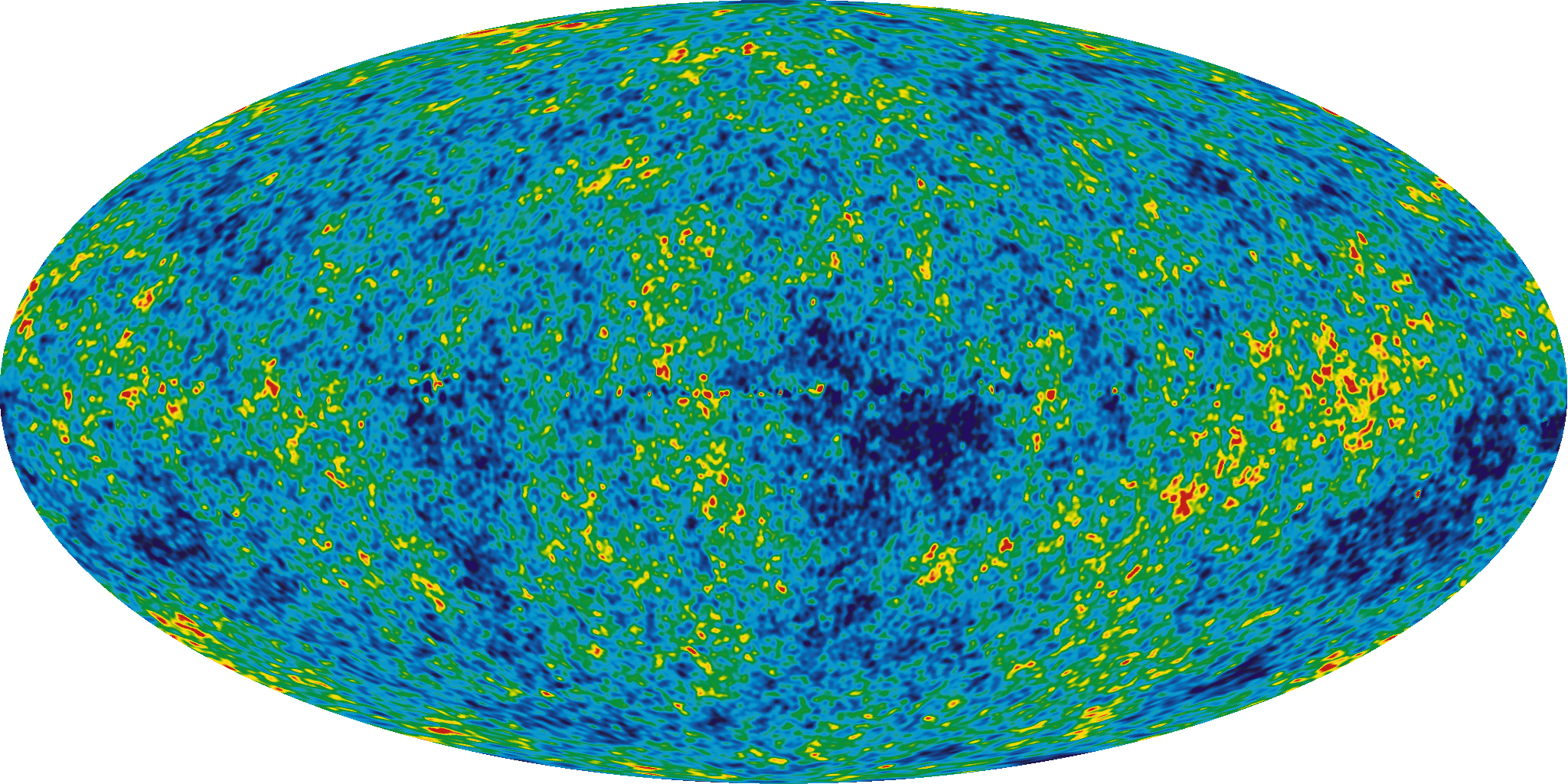
Scientists also use measurements, including the cosmic microwave background, radiation remaining from the early universe. NASA’s WMAP map records small temperature differences in that radiation. It is evidence used to test a physical model, not a picture of creation or a test of what a verse means. The distinction is between agreement with a discovery and words that independently specify it.
Does 51:47 say the universe keeps expanding?
Muhammad Asad translates the key phrase in Qur’an 51:47 as “steadily expanding it.” That is a serious Muslim reading. Older commentaries, however, include divine capacity and making the heavens spacious. It is inaccurate to claim that they speak only of wealth or generosity.
Making something spacious does not necessarily mean its size keeps increasing. A believer may understand the verse as a meaning revealed more fully by later science. The difficulty is proving that this meaning, rather than the older alternatives, follows from the words independently of the discovery. A spiritual interpretation can remain meaningful without establishing uniquely divine scientific knowledge.
What about development in the womb?
Qur’an 23:12–14 describes development through a drop, ʿalaqa, muḍgha (a lump), and bones clothed with flesh. The middle terms have competing interpretations: the discussion of ʿalaqa includes clot and attachment. Choosing one English rendering cannot settle the scientific argument.
In Qur’an 23:14, Pickthall renders part of the sequence: “then fashioned We the little lump bones, then clothed the bones with flesh” (The Meaning of the Glorious Koran, 1930). This shows one translator’s wording; it does not resolve the competing meanings of the terms or establish a modern anatomical correspondence.
Greek medical writers also discussed development in stages. A published historical comparison by Elsakaan and Longo finds similarities and differences with Hippocratic medicine, and treats dependence as an unproved hypothesis. Earlier accounts challenge the claim that stages were entirely unknown. Their existence does not establish Muhammad’s access to them, prove that he copied Galen or reveal a direct route of borrowing. This comparison tests claims of unprecedented description, not every claimed anatomical correspondence. Neither an instant miracle claim nor an instant plagiarism verdict is justified by resemblance alone.
Would the same argument prove the Bible?
Isaiah 40:22 describes God stretching the heavens like a curtain and spreading them like a tent. Christians might connect this with cosmic expansion. But the imagery also makes sense without that discovery. Accepting it as scientific proof while rejecting a broad Qur’anic expression would change the standard halfway through the comparison.
Isaiah 40:22 describes God as the one “who stretches out the heavens like a curtain, and spreads them out like a tent to dwell in” (World English Bible). These are the actual similes being compared; identifying them with a scientific discovery still requires an argument.
Nor does counting attractive examples produce a reliable religious victory percentage. We would need a defined set of claims, a way to count failures and alternatives, and justified probabilities. A personal score such as 75/25 supplies none of that. Several weak matches can share the same weakness: the interpreter already knows which discovery to look for.

Why examine the Christian historical claim?
There is a more concrete Christian claim to investigate. In 1 Corinthians 15:3–8, Paul reports Jesus’ death, burial, resurrection and appearances, naming Cephas and James. In verse 8 he adds his own claim to an appearance. The letter’s composition dates to the 50s CE; this is not the date of a surviving manuscript. This gives us early evidence that Christians proclaimed the resurrection, rather than a modern scientific meaning read into an ancient image.
Paul introduces the message he received in 1 Corinthians 15:3–4: “that Christ died for our sins according to the Scriptures, that he was buried, that he was raised on the third day according to the Scriptures” (World English Bible). This is a concrete Christian proclamation to investigate, not independent proof that the reported event occurred.
Paul also says that if Christ was not raised, Christian faith fails (15:14–17). That puts an identifiable event at the center of the inquiry. His report is not a separately preserved statement from each person he names, and its early date alone does not prove the event. We still need to ask how Paul knew, what other testimony contributes and which explanation best accounts for it. Accurate places or titles would support knowledge of a setting, not prove every event or a book’s divine authority.
Other Islamic arguments still need their own examination. The scientific examples above do not settle the comparison in Islam’s favor. They give a reader reason to examine the Christian testimony on its own evidence, without assuming that a scientific-sounding translation has already ruled it out. The next question is concrete: what best explains the early proclamation that God raised Jesus?