


Preserving a scripture faithfully helps us know which message has reached us. It does not, by itself, establish that the message is true or that God revealed it: accurate copying can transmit a mistake just as faithfully as a truth. Preservation can still contribute to a wider argument, provided there are good reasons for the other steps. If preservation is your reason for accepting the Qur’an as God’s word, this exposes a gap that accurate copying alone cannot close.
Imagine a forecast predicting rain tomorrow. A perfect copy tells us what was predicted; tomorrow’s weather tests the prediction. This invented example illustrates a distinction, not a judgment about either religion. If a message was not from God when first given, copying it accurately would not change its source. Even if one scripture were better preserved than another, that comparison alone would not establish which, if either, was revelation.
The reverse shortcut also fails: a change does not automatically make a statement false. In an invented arithmetic textbook, correcting 7 × 8 = 54 to 7 × 8 = 56 makes that statement true. A change that leaves a true assertion’s meaning intact need not make it false; one that reverses its meaning can matter greatly. We need to identify what changed and what follows from it. These examples establish no particular history for the Qur’an or the Bible.
That distinction helps us read the Qur’an’s own preservation claim. In 15:9, God is presented as the sender and protector of the Reminder. Ibn Kathir’s commentary identifies the Reminder as the Qur’an and understands the protection as protection against alteration. For someone who accepts the Qur’an as revelation, this offers assurance. For someone investigating its authority, the verse identifies a promise to examine; quoting the promise alone does not independently establish who made it.
A stronger Muslim argument joins that promise to evidence of its fulfillment and to other reasons for accepting the revelation. Qur’an 4:82, for example, invites reflection on the text’s consistency. Such a combined case is not answered merely by saying that false statements can be copied. An investigator can examine it without first accepting the Qur’an’s authority; several reasons may support a conclusion together even when none proves it alone.
Human care and divine protection need not be competing explanations for a believer. Yousef Wahb’s account at Yaqeen Institute treats recitation and written copies as complementary means of transmission. The question is what the evidence supports about both the transmission and its claimed divine significance. The same question applies to Christian claims of providential preservation.
It is certainly We Who have revealed the Reminder, and it is certainly We Who will preserve it.
He is the One Who revealed the Dhikr to him, which is the Qur'an, and He is protecting it from being changed or altered.
Do they not then reflect on the Quran? Had it been from anyone other than Allah, they would have certainly found in it many inconsistencies.
This article, however, focuses on the preservation of the Qur’an, orally and textually during the time of its first recipient and conveyor, Prophet Muhammad ﷺ.
Yousef Wahb, How the Qur’an Was Preserved During the Prophet’s Time
One part of the evidence is tangible. The University of Birmingham’s Mingana Islamic Arabic 1572a contains portions of surahs 18–20 on two parchment leaves. Radiocarbon testing gives the parchment a range of 568–645 CE at 95.4% confidence. It dates the animal’s death, not the moment of writing.
These leaves are meaningful early evidence for particular passages. They cannot certify every word or every stage of the whole Qur’an’s transmission. Acknowledging their value and respecting their limits belong together: the evidence deserves examination without being made to settle divine origin on its own.
The radiocarbon result gives the date range for the death of the animal whose skin was used to make the parchment of the manuscript.
Apply that care to the Bible as well. The English Standard Version notes that Mark 16:9–20 is absent from some of the earliest manuscripts. A substantial passage is at issue, not merely spelling. Any argument relying specifically on those verses must address their textual status.
But a problem in this ending does not decide what another biblical witness says or whether its report is reliable. Each relevant passage needs its own assessment. Neither a textual difference nor agreement between copies automatically answers the historical question.
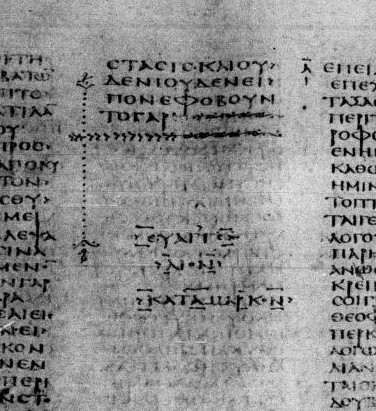
Some of the earliest manuscripts do not include 16:9–20.
Paul’s first letter to the Corinthians gives a concrete reason to consider the Christian claim about God. In 15:3–8,14–17 he reports Jesus’ death, burial, resurrection and appearances, identifies God as the one who raised Christ, and makes Christian faith depend on whether the resurrection happened. The USCCB introduction dates the letter to about 56 CE. This is a specific proclamation from the first Christian generation, not a claim whose existence depends on Mark’s disputed ending.
That is a reason to investigate, not a completed proof. Paul’s report about more than five hundred people is one report, not five hundred independently available witness statements. An early account can be mistaken. Its reliability and explanations of the reported events still need examination; copying it faithfully cannot settle whether a miracle occurred.
For a reader weighing Islam, preservation alone therefore cannot justify accepting the Qur’an’s divine authority or dismissing this Christian testimony in advance. Paul directs our attention to the claim that God raised Jesus: what reasons support trusting that testimony? We can ask how its author could know and which explanation best fits the evidence without first conceding inspiration. Christians must answer with evidence; a criticism of an Islamic argument cannot supply the missing proof.
For I delivered to you first of all that which I also received: that Christ died for our sins according to the Scriptures, that he was buried, that he was raised on the third day according to the Scriptures, and that he appeared to Cephas, then to the twelve. […] If Christ has not been raised, then our preaching is in vain and your faith also is in vain.
To treat this wide spectrum of questions, Paul wrote this letter from Ephesus about the year 56.