


The Dead Sea Scrolls give us ancient Jewish copies of biblical books, including Isaiah from before Jesus. They show that much of the Hebrew Bible was transmitted with substantial continuity, alongside real differences in wording. They do not prove that every letter remained unchanged, that the New Testament was preserved, or that the Bible is divinely inspired. Their value is more concrete: they let us test some claims about what later people changed.
Israel Antiquities Authority: Qumran collection · Israel Museum: Great Isaiah Scroll, p. 2
What was found?
Beginning in 1947, Bedouin discoveries and archaeological work brought ancient writings to light near Qumran, on the northwestern shore of the Dead Sea. Most survive as fragments. The Qumran collection is generally dated from the third century BCE to the first century CE: before and around the beginnings of Christianity, and centuries before Islam. BCE means before the Common Era; CE means the Common Era.
These were Jewish writings, including biblical books, prayers, commentaries and community rules. The Hebrew Bible is the Jewish collection that also forms the core of the Christian Old Testament. It is not the New Testament, the Christian collection containing the Gospels. No New Testament manuscript has been securely identified among the Qumran finds. Finding an Isaiah scroll therefore cannot, by itself, tell us how faithfully Matthew was copied.
Israel Antiquities Authority: Qumran collection · Israel Antiquities Authority: contents
An older copy gives us something to compare
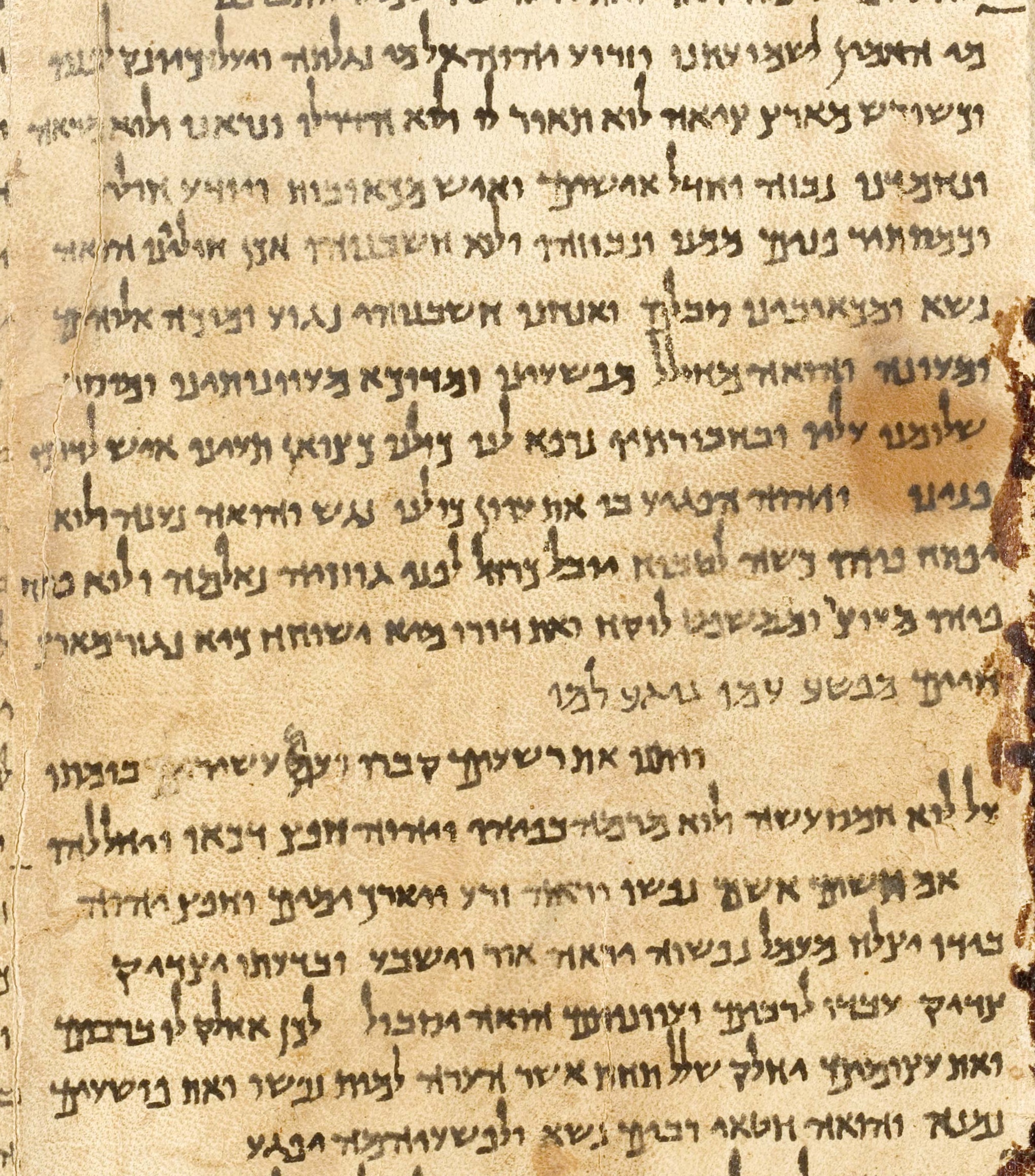
The Great Isaiah Scroll, known as 1QIsaᵃ, preserves the book across 54 columns, with some small damaged areas. The Israel Museum dates it to about 125 BCE. That is an approximate date for this copy, not the date when Isaiah's words were first composed. It is roughly a thousand years older than the major medieval Hebrew manuscripts with which scholars compare it.
The later standard Hebrew tradition is called the Masoretic Text. The discovery did not reveal an entirely unfamiliar Isaiah: readers could recognize the same book. But the copies do not agree at every point. At Isaiah 53:11, for example, the Great Isaiah Scroll includes the word meaning light; the standard Masoretic wording does not. Modern translations often flag this difference in a footnote. It is a difference in the wording, not merely a spelling change.
At Isaiah 53:11 the short Hebrew readings are “יראה ישבע” in the Masoretic Text and “יראה אור וישבע” in 1QIsaᵃ. Our brief renderings are “he will see; he will be satisfied” and “he will see light and be satisfied” (Hebrew readings reproduced in Anthony Ferguson’s witness table). This shows the wording being compared; it does not identify the servant.
That example explains why a claim such as “95% identical” is not a reliable summary on its own. Which copies were compared? Were letters, words or passages counted? How were missing pieces handled? An overall score cannot tell us whether one important sentence differs. Scholars must compare particular readings and explain which one they judge earlier.
Emanuel Tov: Understanding the Text of the Bible (2014), pp. 89–96
Does Isaiah 53 prove a prediction about Jesus?
The scroll establishes that Isaiah 53 existed before Christianity. Christians did not invent that passage after Jesus' death. It describes a servant suffering in connection with others' wrongdoing and later being vindicated. Acts 8:26–35 connects the passage with Jesus; 1 Peter 2:21–25 explains his suffering as bearing sins so that people can live rightly before God. This is the Christian claim that makes the older passage worth examining.
Acts 8:35 describes Philip’s response: “beginning from this Scripture, preached to him about Jesus”. 1 Peter 2:24 explains the Christian claim: “He himself bore our sins in his body on the tree, that we, having died to sins, might live to righteousness.” (World English Bible). The passages show how Christians connect Isaiah with Jesus and salvation; they do not make manuscript age a proof of fulfillment.
But the date does not identify the servant. Rashi, an influential Jewish commentator, reads the servant here as Israel. The wider book itself calls Israel God's servant in Isaiah 49:3. A Christian reading must explain the passage and its wider context, and relate it to the evidence about Jesus. The scroll gives that discussion an ancient text; it does not decide the interpretation for us.

Israel Museum: Great Isaiah Scroll, p. 2 · Isaiah 52:13–53:12, NRSVUE · Isaiah 49:3–6, NRSVUE
What does this change in a comparison with Islam?
An accusation that earlier scripture was distorted needs a clear meaning. Qur'an 3:78 accuses some people of presenting something through their speech as scripture when it is not; 2:79 also condemns writing something and attributing it to God. The Muslim scholarly encyclopedia TDV describes different views about distortion of wording and meaning. These charges should not automatically be treated as a claim that every biblical manuscript was replaced. A manuscript comparison tests wording, not whether someone interprets it honestly.
If someone claims that Christians added Isaiah 53 after Jesus, the pre-Christian copy is decisive evidence against that particular claim. If the claim concerns changes before our earliest surviving copy, or a different biblical passage, this scroll does not settle it. Neither does the discovery of variants establish that the whole Bible became a replacement for a lost revelation.
A Muslim can accept this history and still reject the Christian reading. Shabir Ally, for example, distinguishes the scrolls' historical value from religious authority. Some Muslims use the Qur'an as the standard for judging earlier scripture, an approach connected with its claim in 5:48. The scroll's age does not settle whether the Qur'an has that authority, nor does it show that Islam is false.
For a Muslim reader considering Christianity, the positive reason to investigate is concrete: a passage central to its account of suffering and salvation survives in a Jewish copy older than Christianity. Its history is open to comparison. Instead of dismissing it as inaccessible or wholly late, we can ask what it means and whether the Christian account of Jesus makes sense of it. A preservation percentage cannot answer that question for us.